Project momentum is easiest to lose right when the work finally gets “real.” Once development begins, Digital Transformation Executives and Product Leads often see a familiar pattern: the roadmap looks approved, the team is staffed, and then delivery slows under the weight of decisions, dependencies, and unclear ownership.
The fix is not more urgency, it is more structure. In this guide, we’ll define project momentum, then walk through milestone-driven development, decision gates, and project handoff best practices that keep delivery moving without sacrificing governance. For more practical frameworks, browse Southern Made’s Partner Playbook insights.
Want a partner who can help you build the rituals and reporting that keep delivery on track? Catch Up on The Latest and see how Southern Made supports teams from discovery through launch.
Key Takeaways
- Momentum is measurable: project momentum shows up as predictable decision cadence and stable delivery velocity.
- Milestones reduce ambiguity: milestone-driven project management turns “progress” into outcomes you can verify.
- Decision gates protect speed: decision gates in project development prevent rework and unblock teams faster.
- Handoffs require design: project handoff best practices keep context intact across teams and vendors.
- Metrics keep teams honest: lightweight internal reporting sustains focus when pressure rises.
Understanding Project Momentum: Definition and Importance
Project momentum is the sustained ability to turn intent into delivered increments without repeated stops and restarts. A practical project momentum definition is “consistent forward movement across planning, build, and release, supported by clear decisions, stable priorities, and visible progress.” It is not the same as being busy.
For a Chief Digital Officer running parallel initiatives across business units, momentum is often lost in the seams: one group is ready to build, another is still debating scope, and security or legal arrives late with non-negotiables. For an Event Experience Director, momentum can disappear when venue constraints, hardware procurement, and content approvals collide in the final weeks before launch.
What momentum looks like in practice
In our experience, healthy momentum has a distinct feel:
- Decisions happen on a schedule, not “when someone has time.”
- Work is sliced into shippable increments, not giant releases that hide risk.
- Risks surface early, because the team has a safe, consistent way to raise them.
A common scenario is a product team that exits discovery with a solid prototype, then enters development and immediately re-litigates requirements because success criteria were never operationalized. The result is churn: engineers build, stakeholders revise, and timelines slip.
One helpful reframe for executives is to treat momentum as a portfolio asset. When momentum drops, you pay twice: once in delivery cost (rework, idle time, vendor extensions) and again in opportunity cost (missed market windows, delayed adoption). Southern Made often covers this “from idea to impact” gap in our Partner Playbook articles, especially when multiple partners share delivery.

Momentum becomes much easier to protect when you stop treating it as a vibe and start designing it into the plan, beginning with milestones.
Milestone-Driven Project Management: Structuring Momentum
Milestone-driven project management works because it replaces ambiguous progress with verifiable outcomes. If your plan only lists tasks, teams can “complete work” for weeks without producing anything a stakeholder can evaluate. Milestones force alignment on what “done” means at meaningful points in time.
Milestones are most effective when they describe an artifact or capability, not an activity. “API endpoints implemented” is still an internal activity. “Partner can create and redeem a token in staging with audit logging enabled” is a capability that can be validated.
A milestone model that holds up under real delivery pressure
For digital products and interactive experiences, a simple model is:
- Milestone 0: Delivery Readiness. Environments, access, security constraints, and team roles are confirmed.
- Milestone 1: Vertical Slice. One thin, end-to-end flow works, even if it is ugly.
- Milestone 2: Feature Complete. All agreed capabilities exist, gaps are known and prioritized.
- Milestone 3: Release Candidate. Performance, compliance, and content are validated.
- Milestone 4: Launch and Learn. You ship, monitor, and capture next-iteration opportunities.
Notice what is missing: a promise that every stakeholder idea will be included. Milestones protect project momentum by limiting the surface area of debate. They also help vendor-managed work stay transparent, because each milestone becomes a shared checkpoint.
For example, an experiential campaign with WebAR might define Milestone 1 as “Scan to launch, permissions prompt, and first 3D asset renders on iOS and Android on venue Wi-Fi.” That milestone de-risks the hardest part early, before creative iteration accelerates.
If you need governance language that works across agencies, internal teams, and external vendors, Southern Made frequently shares patterns like these in the Partner Playbook archives.
The next layer that makes milestones “stick” is decision gates, because milestones without decisions still allow drift.
Decision Gates in Project Development: Ensuring Consistent Forward Movement
Decision gates in project development are pre-scheduled moments where leaders either approve forward motion or intentionally change course. They keep teams from building in a vacuum, and they prevent late surprises from security, legal, brand, or operations.
A decision gate should answer one question: “Are we confident enough to spend the next tranche of time and money?” That confidence is earned by evidence, not optimism.
How to design a decision gate that teams will actually use
Effective gates share three traits:
- Clear inputs: what must be demonstrated (demo, test results, updated scope, risk log).
- Named decision owner: one accountable person, not a committee vote.
- Pre-agreed options: go, go with constraints, or pause with a specific remediation plan.
For a Digital Transformation Executive, a gate is also where alignment meets compliance. If you are touching customer data or identity, you can anchor the gate to recognized frameworks like the NIST Cybersecurity Framework so risk conversations stay grounded.
Here is a practical example: after a vertical slice milestone, the team runs a gate where they review page-load targets, authentication approach, and logging requirements. If the evidence shows performance risk, the decision is not “work harder,” it is “reduce scope” or “change architecture” now, while change is still cheap.
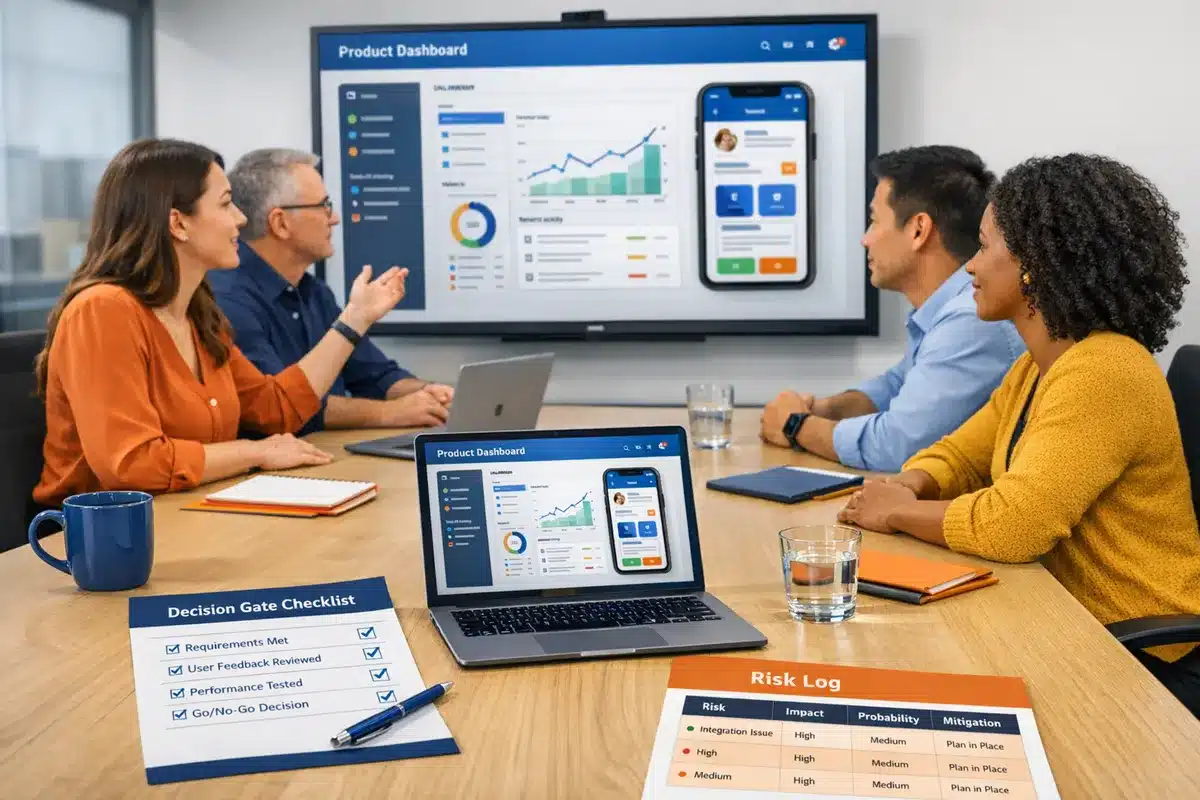
Decision gates keep momentum by making the hard choices routine. Once decisions are dependable, handoffs and governance rituals can carry that cadence through every phase.
Maintaining Project Momentum Through Clear Handoffs and Governance Rituals
Most delivery slowdowns come from invisible work: clarifying, translating, and re-explaining context. That is why project handoff best practices matter as much as engineering output. When handoffs are vague, teams rebuild understanding from scratch, and project momentum drops even if everyone is working full time.
Instead of treating handoffs as a meeting, treat them as a product: a repeatable package that reduces uncertainty.
What a “clean handoff” includes (and what it avoids)
A strong handoff package usually includes:
- Decision history: what was decided, by whom, and why (prevents relitigation).
- Definition of done: acceptance criteria per milestone, plus non-functional requirements.
- System context: integrations, constraints, and environment access.
- Operational notes: who supports launch, incident paths, and SLAs if relevant.
What it avoids is a 60-slide deck that nobody reads. The goal is shared visibility, not documentation theater.
Governance rituals then keep that visibility alive. Two lightweight rituals we see work across enterprises, agencies, and fast-moving product teams:
- Weekly Momentum Review (30 minutes): milestone status, decisions needed, risks, and blockers. This is not a status recital, it is a decision-making forum.
- Mid-sprint Stakeholder Demo (15 minutes): a short demo that forces real progress and prevents surprises.
For an Event Experience Director coordinating logistics, content, and tech, these rituals prevent the classic “creative approval meets venue reality” crunch. For a Product Lead integrating emerging tech, they keep feasibility and UX aligned when experimentation is involved.
Southern Made often acts as the connective tissue across disciplines (design, dev, 3D, experiential) so handoffs stay crisp from discovery to build to launch. You can find more collaboration patterns in our Partner Playbook posts.
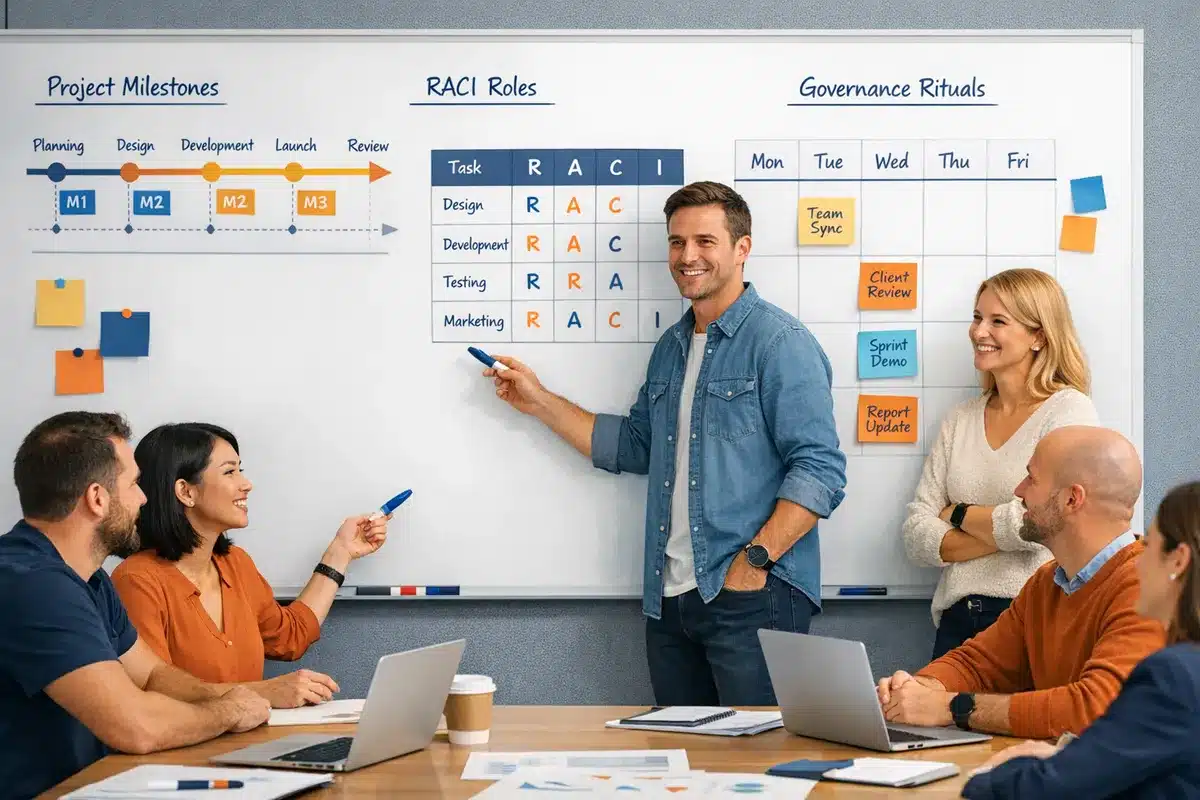
Once handoffs and rituals are in place, the final piece is measurement, because you cannot sustain what you cannot see.
Measuring Momentum: Using Metrics to Sustain Delivery Velocity
The fastest teams do not “feel” on track, they can prove it. Measuring momentum does not require heavyweight PMOs or invasive time tracking. It requires a small set of internal project metrics that show whether cadence adherence and delivery velocity are holding steady.
A practical starter set:
- Cadence adherence: percent of planned ceremonies and gates held on time, and percent of decisions made within the agreed SLA (for example, 48 hours).
- Milestone burndown: movement of scope into “accepted” at the milestone level, not task completion.
- Rework rate: count of reopened stories, reversed decisions, or late requirement changes.
- Flow time: how long a work item takes from “in progress” to “accepted.”
For teams using Agile practices, you can align with widely used delivery research like Google Cloud’s DORA guidance on throughput and stability, see State of DevOps resources. The point is not to copy a benchmark, it is to notice trend lines early.
Here is a simple internal proof pattern we use with clients: if cadence adherence stays above 90 percent and decision SLAs stay under two business days, delivery velocity usually stabilizes even when complexity rises. When either metric slips, you can predict the slowdown before it hits launch dates.
Metrics should drive conversations, not consequences. If people fear the numbers, they will game them. Keep reporting focused on removing blockers and improving clarity. If you want more examples of lightweight reporting that supports executives without slowing teams down, Southern Made shares approaches like this in the Partner Playbook archives.
Ready to build a momentum dashboard that leadership trusts and teams actually use? Contact Us to map milestones, gates, and metrics to your next build.
Frequently Asked Questions About Project Momentum
What is the best project momentum definition for executives?
A useful project momentum definition is “predictable progress that converts investment into validated delivery increments.” Executives should look for repeatable decision cadence, stable milestones, and decreasing uncertainty over time. If teams cannot show what was accepted in the last one to two weeks, or if decisions constantly roll over, momentum is likely being confused with activity.
How to maintain project momentum when multiple business units must approve work?
The most reliable way to maintain project momentum is to time-box approvals into decision gates with named owners. Instead of chasing feedback ad hoc, schedule gates tied to milestones and require specific evidence (demo, compliance notes, risks). This approach respects stakeholders’ time while preventing “approval debt” that surfaces late as rework.
Do milestones slow teams down compared to Agile delivery?
No, milestones usually speed teams up when they describe outcomes, not bureaucracy. Milestones complement Agile by giving stakeholders clear acceptance points while engineers still work in small increments. The key is to keep milestones few, evidence-based, and connected to decisions. If milestones turn into extra paperwork, the design is wrong, not the concept.
Your Next Steps to Keep Delivery Moving
Project momentum is not automatic, it is engineered through clarity, cadence, and shared accountability. When milestones define outcomes, decision gates make choices routine, and handoffs preserve context, teams keep moving even as work intensifies.
If you are seeing slowdowns at the start of development, start small: lock a vertical slice milestone, schedule the next two decision gates, and publish a one-page handoff package. Clear visibility beats heroic effort every time.
Southern Made is a digital solutions lab. We handcraft distinct, memorable experiences for your brand and your fans. Explore more practical guidance in the Partner Playbook, and when you are ready, let’s build momentum together.

I build teams and systems that turn complex ideas into simple, working products. As CEO of Southern Made, I lead a team of project managers, designers, developers, and strategists who help agencies and brands bring big ideas to life. For over 25 years, I’ve worked at the intersection of product design, technology, and entrepreneurship, learning how to balance creativity with execution. My focus has always been the same: remove friction, move fast, and make work that matters.